In an interview with the Guardian, Stephen Hawking dismissed the notion that humans have a soul, stating that "I regard the brain as a computer which will stop working when its components fail. There is no heaven or afterlife for broken down computers; that is a fairy story for people afraid of the dark."
Hawking's materialistic view that the mind is a naturally evolved computer is rooted in modern science. Since the cognitive revolution of the 1950s, many neuroscientists, psychologists, and computer scientists have used the "mind as a computer" metaphor to guide their investigations of how the brain engages in complex information processing, such as the symbol manipulation that is an integral part of language.
In previous interviews, Hawking has also expressed skepticism about the existence of God. When asked by the Guardian how we are supposed to live if there is no God to provide us with guidance, Hawking gave a simple but I think brilliant answer. "We should" he said, "seek the greatest value of our action."
Wednesday, May 18, 2011
Friday, May 13, 2011
The reports of Freud's death have been greatly exaggerated
For years, academic psychologists have proclaimed that Freud is dead, but recently, new findings have come to light that undermine the conventional wisdom about his legacy. For example, Mark Solms has presented evidence that supports a number of Freud's ideas, including his assumption that dreams are not meaningless psychic phenomena, but motivated, wishful states. Additionally, Jonathan Shedler published a study in American Psychologist last year that showed that Freudian therapeutic treatments are just as effective as newer, so-called "evidence-based" approaches to psychotherapy.
Here is a link to an article by Mark Solms:
http://mysite.verizon.net/res0im1v/donettesteelepsychology/id19.html
Here is a link to the APA page that describes Shedler's study:
http://www.apa.org/news/press/releases/2010/01/psychodynamic-therapy.aspx
Here is a link to an article by Mark Solms:
http://mysite.verizon.net/res0im1v/donettesteelepsychology/id19.html
Here is a link to the APA page that describes Shedler's study:
http://www.apa.org/news/press/releases/2010/01/psychodynamic-therapy.aspx
Wednesday, February 2, 2011
Go For Green Contest
The DLN is giving a daily cash prize to the first person who finds the four-digit daily cash code in the print edition of the paper and enters it on the online contest page.
Here are the details:
http://dailylocal.com/articles/2011/02/01/online/doc4d484e205228d165780366.txt
Kevin J. White of Prospect Park won the first prize of $100. There are 42 more chances to win.You could be the next winner!
Here are the details:
http://dailylocal.com/articles/2011/02/01/online/doc4d484e205228d165780366.txt
Kevin J. White of Prospect Park won the first prize of $100. There are 42 more chances to win.You could be the next winner!
Thursday, January 27, 2011
The stuff that dreams are made of
Some of my fondest childhood memories are of snowstorms, and the magic, wonder, and excitement that surrounded them. Indeed, I can remember looking at leaden skies, and listening to KYW, hearing about storms and rumors of storms, in the otherworldly sibilance of the AM dial. How I desperately wanted not 2 to 4, 3 to 6, 4 to 8, but 6 to 10 inches of snow to transform the landscape into a world of white wonder, one in which a day off from school wasn't the thing of sleepy wishes, but a dream come true.
Some of those snow dreams stand out in memory; for example, I clearly recall the Blizzard of 1983. I was sick when it began, and was laying in bed, watching the snow whirl past my window, and listening to the wind howl through the trees in my backyard. I recovered in time to venture out into the drifts, build a snowfort, and defend my yard from all would-be invaders, who arrived looking like terrorists, wearing ski masks, and menacingly holding a snowball in their right hand.
My recollection of other storms is a bit hazier, and something like trying to remember a dream after a long and deep sleep. Among those storms I include the legendary Blizzard of 1978. I was very young at the time, but I seem to recall looking out the window at drifts that were like waves on a dazzling white ocean.
I wonder if some day we will look back on the storms of 2010 and 2011 with the same sense of magic and mystery. I somehow doubt it, as the dreamworld of childhood has given way to the harsh realities of life. These days, I am as likely to curse the snow as I am to marvel at its wonder. But there is still something of the magic left, for I laugh when I see kids playing in the snow, and try to remember that for all its troubles, it's still the stuff that dreams are made of.
Some of those snow dreams stand out in memory; for example, I clearly recall the Blizzard of 1983. I was sick when it began, and was laying in bed, watching the snow whirl past my window, and listening to the wind howl through the trees in my backyard. I recovered in time to venture out into the drifts, build a snowfort, and defend my yard from all would-be invaders, who arrived looking like terrorists, wearing ski masks, and menacingly holding a snowball in their right hand.
![]() |
| A child playing in the snow after the Blizzard of 1978. |
My recollection of other storms is a bit hazier, and something like trying to remember a dream after a long and deep sleep. Among those storms I include the legendary Blizzard of 1978. I was very young at the time, but I seem to recall looking out the window at drifts that were like waves on a dazzling white ocean.
I wonder if some day we will look back on the storms of 2010 and 2011 with the same sense of magic and mystery. I somehow doubt it, as the dreamworld of childhood has given way to the harsh realities of life. These days, I am as likely to curse the snow as I am to marvel at its wonder. But there is still something of the magic left, for I laugh when I see kids playing in the snow, and try to remember that for all its troubles, it's still the stuff that dreams are made of.
Monday, December 6, 2010
Follow the DLN on Twitter and get a gift card!
The Daily Local News is giving away a ton of gift cards to local restaurants and other merchants during the holidays. For a chance to win, just follow @wcdailylocal on Twitter.
Here is where you can add the the Daily Local to your Twitter feed:
http://twitter.com/invitations/find_on_twitter
Take advantage of this opportunity, before time runs out, and all the prizes are history!
Happy holidays,
Joe
Here is where you can add the the Daily Local to your Twitter feed:
http://twitter.com/invitations/find_on_twitter
Take advantage of this opportunity, before time runs out, and all the prizes are history!
Happy holidays,
Joe
Wednesday, December 1, 2010
The story behind Lincoln's first biography
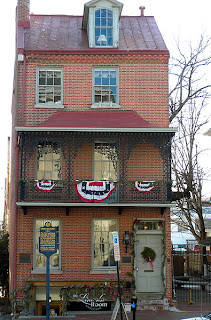
Chester County holds a unique place in the annals of Lincoln lore. Indeed, the first biography of our 16th president was published in West Chester on February 11th, 1860, by the Chester County Times, a local Republican weekly that was owned by Samuel Downing and located at 14 W. Market Street.
At the time, 14 W. Market was known as the Everhart Building. Today, the building is numbered 28 W. Market, and is named the Lincoln Building.
The story behind why Lincoln's biography was published in West Chester is nothing short of remarkable. One of Lincoln's friends in Illinois was Jesse W. Fell, a native of Chester County who settled in Illinois in 1835. Fell met Lincoln while the two were staying at the same boarding house, and they struck up a lifelong friendship.
In 1858, when Lincoln ran for senate against Senator Stephen Douglas, Fell urged him to debate Douglas over the senator's signature piece of legislation, the Kansas-Nebraska Act. Lincoln thought the idea was a good one, and he challenged Douglas to a series of debates. Douglas accepted, and during the summer and fall of 1858, Lincoln and Douglas sparred over the Kansas-Nebraska Act in a series of now legendary public exchanges known as the “Lincoln-Douglas debates.”
When Lincoln started being mentioned as a candidate for president in 1860, Fell worried that his friend, still unknown outside of Illinois, would have trouble getting votes back East. He and an Illinois newspaper publisher named Edward Lewis urged Lincoln to write some autobiographical notes that could be used to introduce him as a candidate for president to Eastern voters.
"I was born February 12, 1809, in Hardin County, KY. My parents were born in Virginia, of undistinguished families -- second families, perhaps I should say. My mother, who died in my tenth year, was of a family of the name of Hanks, some whom now reside in Adams and others in Macon Counties, Ill."
"My paternal grandfather, Abraham Lincoln, emigrated from Rockingham County, Va., to Kentucky, about 1781 or '82, where, a year or two later, he was killed by Indians, not in battle, but by stealth, when he was laboring to open a farm in the forest. His ancestors, who were Quakers, went to Virginia from Berks County, Pa.. An effort to identify them with the New England family of the same name ended in nothing more than a similarity of Christian names in both families, such as Enoch, Levi, Mordecai, Solomon, Abraham and the like."
"My father, at the death of his father, was but six years of age, and he grew up literally without education. He removed from Kentucky to what is now Spencer County, Ind., in my eighth year. We reached our new home about the time the State came into the Union. It was a wild region, with many bears and other wild animals still in the woods. There I grew up. There were some schools, so called, but no qualification was ever required of a teacher beyond "readin', writin' and cipherin'" to the Rule of Three. If a straggler supposed to understand Latin happened to sojourn in the neighborhood, he was looked upon as a wizard. There was absolutely nothing to excite ambition for education."
"Of course when I came of age I did not know much. Still, somehow, I could read, write and cipher to the Rule of Three, but that was all. I have not been to school since. The little advance I now have upon this store of education I have picked up from time to time under the pressure of necessity."
"I was raised to farm-work, which I continued till I was twenty-two. At twenty-one I came to Illinois, and passed the first year in Macon County. Then I got to New Salem, at that time in Sangamon, now in Menard, County, where I remained a year as a sort of clerk in a store. Then came the Black Hawk War, and I was elected a captain of volunteers -- a success which gave me more pleasure than any I have had since. I went through the campaign, ran for the Legislature the same year (1832), and was beaten -- the only time I have ever been beaten by the people. The next and three succeeding biennial elections I was elected to the Legislature. I was not a candidate afterwards. During this legislative period I had studied law, and removed to Springfield to practice it. In 1846 I was once elected to the Lower House of Congress, but was not a candidate for re-election. From 1849-1854, both inclusive, practiced law more assiduously than ever before. Always a Whig in politics, and generally on the Whig electoral tickets, making active canvasses. I was losing interest in politics, when the repeal of the Missouri Compromise aroused me again. What I have done since then is pretty well known."
"If any personal description of me is thought desirable, it may be said, I am, in height, six feet four inches nearly; lean in flesh, weighing, on an average, one hundred and eighty pounds; dark complexion, with coarse black hair, and gray eyes. No other marks or brands recollected."
Yours very truly,
A. Lincoln
At the time, 14 W. Market was known as the Everhart Building. Today, the building is numbered 28 W. Market, and is named the Lincoln Building.
The story behind why Lincoln's biography was published in West Chester is nothing short of remarkable. One of Lincoln's friends in Illinois was Jesse W. Fell, a native of Chester County who settled in Illinois in 1835. Fell met Lincoln while the two were staying at the same boarding house, and they struck up a lifelong friendship.
In 1858, when Lincoln ran for senate against Senator Stephen Douglas, Fell urged him to debate Douglas over the senator's signature piece of legislation, the Kansas-Nebraska Act. Lincoln thought the idea was a good one, and he challenged Douglas to a series of debates. Douglas accepted, and during the summer and fall of 1858, Lincoln and Douglas sparred over the Kansas-Nebraska Act in a series of now legendary public exchanges known as the “Lincoln-Douglas debates.”
When Lincoln started being mentioned as a candidate for president in 1860, Fell worried that his friend, still unknown outside of Illinois, would have trouble getting votes back East. He and an Illinois newspaper publisher named Edward Lewis urged Lincoln to write some autobiographical notes that could be used to introduce him as a candidate for president to Eastern voters.
![]() |
| The Lincoln Building |
Lewis's brother, Joseph J. Lewis, was a prominent attorney who lived in West Chester, and was well-known for his antislavery views. His office was located at the Everhart Building, which as the reader will recall, also housed the Chester County Times, owned by Samuel Downing.
Sometime in early 1860, Joseph Lewis and Downing received a three-page, handwritten biographical sketch from Abraham Lincoln. The sketch was used as the primary source material for the biography.
Lincoln's original notes to Lewis and Downing read as follows:
"I was born February 12, 1809, in Hardin County, KY. My parents were born in Virginia, of undistinguished families -- second families, perhaps I should say. My mother, who died in my tenth year, was of a family of the name of Hanks, some whom now reside in Adams and others in Macon Counties, Ill."
"My paternal grandfather, Abraham Lincoln, emigrated from Rockingham County, Va., to Kentucky, about 1781 or '82, where, a year or two later, he was killed by Indians, not in battle, but by stealth, when he was laboring to open a farm in the forest. His ancestors, who were Quakers, went to Virginia from Berks County, Pa.. An effort to identify them with the New England family of the same name ended in nothing more than a similarity of Christian names in both families, such as Enoch, Levi, Mordecai, Solomon, Abraham and the like."
"My father, at the death of his father, was but six years of age, and he grew up literally without education. He removed from Kentucky to what is now Spencer County, Ind., in my eighth year. We reached our new home about the time the State came into the Union. It was a wild region, with many bears and other wild animals still in the woods. There I grew up. There were some schools, so called, but no qualification was ever required of a teacher beyond "readin', writin' and cipherin'" to the Rule of Three. If a straggler supposed to understand Latin happened to sojourn in the neighborhood, he was looked upon as a wizard. There was absolutely nothing to excite ambition for education."
"Of course when I came of age I did not know much. Still, somehow, I could read, write and cipher to the Rule of Three, but that was all. I have not been to school since. The little advance I now have upon this store of education I have picked up from time to time under the pressure of necessity."
"I was raised to farm-work, which I continued till I was twenty-two. At twenty-one I came to Illinois, and passed the first year in Macon County. Then I got to New Salem, at that time in Sangamon, now in Menard, County, where I remained a year as a sort of clerk in a store. Then came the Black Hawk War, and I was elected a captain of volunteers -- a success which gave me more pleasure than any I have had since. I went through the campaign, ran for the Legislature the same year (1832), and was beaten -- the only time I have ever been beaten by the people. The next and three succeeding biennial elections I was elected to the Legislature. I was not a candidate afterwards. During this legislative period I had studied law, and removed to Springfield to practice it. In 1846 I was once elected to the Lower House of Congress, but was not a candidate for re-election. From 1849-1854, both inclusive, practiced law more assiduously than ever before. Always a Whig in politics, and generally on the Whig electoral tickets, making active canvasses. I was losing interest in politics, when the repeal of the Missouri Compromise aroused me again. What I have done since then is pretty well known."
"If any personal description of me is thought desirable, it may be said, I am, in height, six feet four inches nearly; lean in flesh, weighing, on an average, one hundred and eighty pounds; dark complexion, with coarse black hair, and gray eyes. No other marks or brands recollected."
Yours very truly,
A. Lincoln
Monday, October 18, 2010
I'm Abraham Lincoln, and I approved this message.
As we approach the 150th anniversary of the election of 1860, it's natural to wonder how Lincoln would fare in the age of modern politics. One can only imagine how the great man, who preferred using reason rather than emotion to persuade voters, would have navigated the current political landscape. Can you imagine him using focus groups, taking polls, and running attack ads? Just picture it-Lincoln, after implying that his opponent didn't pay Social Security taxes on a nanny that was here illegally, sent racy text messages to a young campaign staffer, and was in the pockets of teacher's unions, ends the ad with the words "I'm Abraham Lincoln, and I approved this message," spoken in a sharp, Kentucky backwoodsman twang that would grate on the ears of voters today like fingernails going down a chalkboard.
It's interesting to consider how Lincoln would fare in today's political climate, but to some extent it's a naive exercise, as he created key elements of it. For example, image-making is perhaps the most important component of modern politics, and Lincoln was a shrewd practitioner of the craft. Indeed, by allowing his people to market him not as an established railroad attorney, but the "rail splitter" during the election of 1860, Lincoln sent a clear message to the voters- that he was not afraid to role up his sleeves and confront the issues then tearing at the fabric of American democracy.
Perhaps Lincoln's greatest contribution to the practice of political image-making was his pioneering use of visual imagery. For example, he was the first president to make extensive use of photography, using that medium to portray himself as a resolute commander-in-chief during the dark days of the Civil War. Indeed, when looking at the picture of steely resolve above, one gains a new appreciation for the cliche "the medium is the message," and voters got the message-that Lincoln meant to win the war, preserve the Union, and bear witness to a "new birth of freedom," loud and clear.
It's interesting to consider how Lincoln would fare in today's political climate, but to some extent it's a naive exercise, as he created key elements of it. For example, image-making is perhaps the most important component of modern politics, and Lincoln was a shrewd practitioner of the craft. Indeed, by allowing his people to market him not as an established railroad attorney, but the "rail splitter" during the election of 1860, Lincoln sent a clear message to the voters- that he was not afraid to role up his sleeves and confront the issues then tearing at the fabric of American democracy.
Perhaps Lincoln's greatest contribution to the practice of political image-making was his pioneering use of visual imagery. For example, he was the first president to make extensive use of photography, using that medium to portray himself as a resolute commander-in-chief during the dark days of the Civil War. Indeed, when looking at the picture of steely resolve above, one gains a new appreciation for the cliche "the medium is the message," and voters got the message-that Lincoln meant to win the war, preserve the Union, and bear witness to a "new birth of freedom," loud and clear.
Subscribe to:
Posts (Atom)


